The founder had a problem he didn’t see coming.
He had built the product. He knew every feature, every pricing edge case, every integration quirk. He could answer any customer question in his sleep — because he’d answered each one dozens of times.
Then he hired his first salesperson.
Suddenly, every customer conversation required his involvement. Either he sat in on the call, or he spent an hour debriefing afterward, explaining the nuance that wasn’t in any document. His calendar filled up. His weekends disappeared. And the worst part? He couldn’t tell whether his new hire was actually learning — or just sounding confident.
This is the story of how one B2B SaaS founder fixed that bottleneck.
The setup: the founder as the knowledge base
The company sells project management and collaboration software to creative agencies and design studios. The product is specialized — built around the way creative teams actually work, with features that don’t map neatly to generic project management tools.
The founder had built the product from scratch. He knew it cold. But the knowledge existed almost entirely in his head.
The pricing guide was on the website. The feature list was documented. But the nuance — “this feature works differently for agencies with more than 50 users” or “that integration requires a specific permission setting” — lived only in the founder’s memory.
When the first sales hire joined, the founder expected to spend a few weeks training them. He didn’t expect to still be sitting in on every call six months later.
But that’s what happened. Every time the new hire had a customer question the documents didn’t cover, they came to the founder. Every time they weren’t sure about a pricing edge case, they came to the founder. Every time they closed a deal, the founder had been on the call.
“I thought hiring a salesperson would get me out of sales. Instead, I was more involved than ever — because I was the only one who actually knew the product well enough to answer the hard questions.”
The cost of being the bottleneck
The founder tracked the impact for three months:
- He was spending 12+ hours per week on sales calls and debriefs that should have been handled by the sales hire
- 4 out of 5 customer questions that came up in sales conversations weren’t covered in any existing document
- The sales hire was 6 weeks in and still couldn’t run a full discovery call without the founder present
The founder was the bottleneck. Not because the sales hire wasn’t capable — because the knowledge the hire needed didn’t exist anywhere except in the founder’s head.
The traditional solution would have been to document everything. Write a sales playbook. Build a knowledge base. Create training materials. But the founder was already working 60-hour weeks. Writing documentation wasn’t going to happen.
The intervention: turning what already existed into onboarding
The founder didn’t write a single new document.
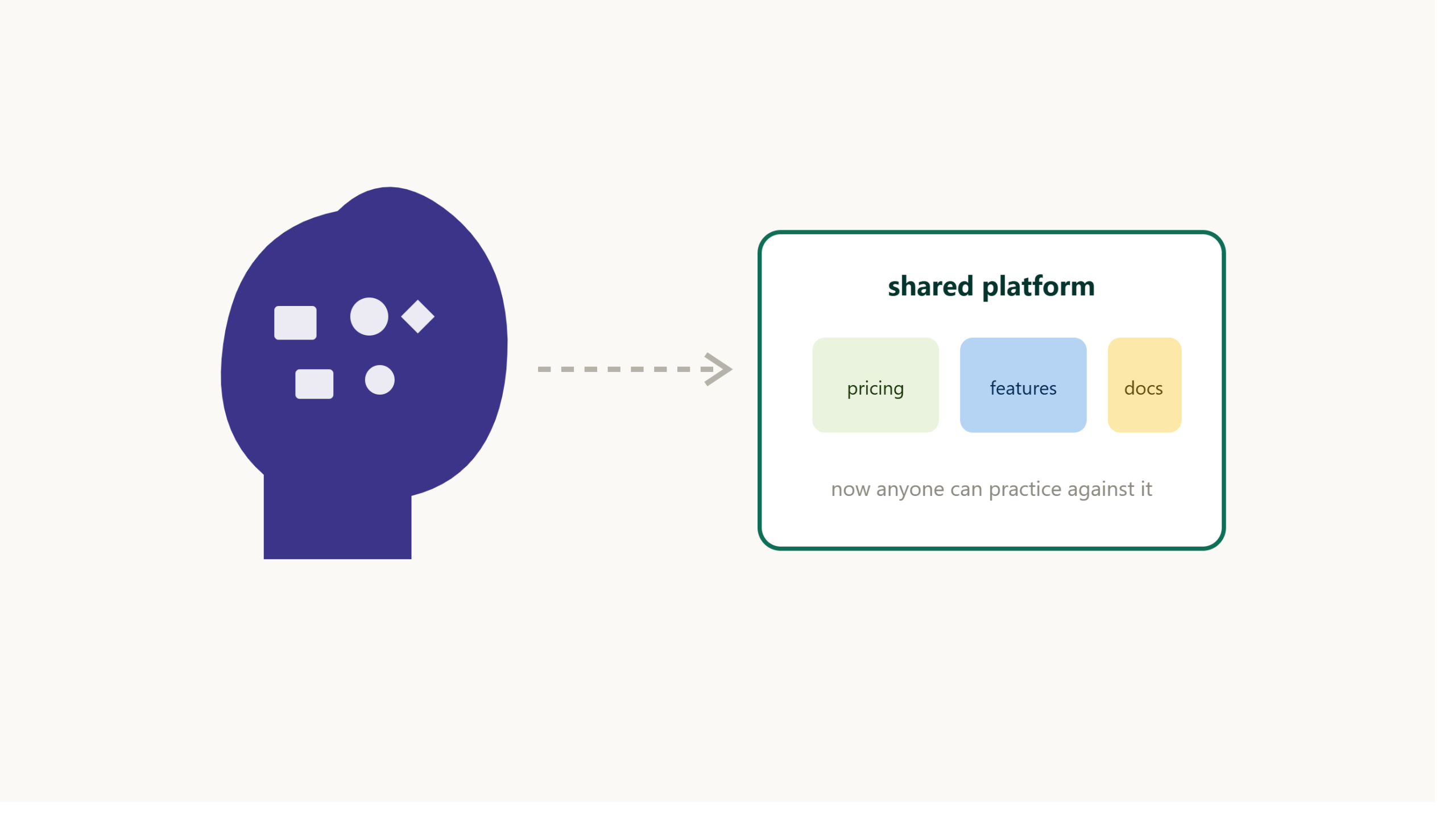
Instead, he used EOS (app.akaeos.com), which turned his existing materials — his website, his pricing page, his feature documentation — into an onboarding curriculum that also checked whether the information had actually landed.
EOS did four things:
- It ingested what already existed. The founder pasted their website URL and uploaded their existing product documentation. No new documents needed to be written. The platform used what was already there.
- It generated practice personas automatically. Instead of the founder writing scripts for roleplay scenarios, the platform created customer personas based on the company’s actual product and market.
- It checked every claim. When the sales hire practiced a conversation, the platform extracted every factual claim and checked it against the company’s documentation. Each claim was tagged Correct, Partially Correct, Incorrect, or Unsupported.
- It auto-generated quizzes for every miss. When the hire made an error, the platform generated a follow-up quiz targeted at exactly what they got wrong — not a generic refresher, but a specific correction with a citation.
The founder didn’t write training materials. He didn’t build a curriculum. He didn’t create practice scenarios. He just pointed the platform at what he already had.
What changed in the first month
The founder ran the pilot with his single sales hire.
- The founder stopped sitting in on every call. The sales hire could practice independently, get feedback from the platform, and correct errors before they reached a live customer. The founder only reviewed the summary reports on his own dashboard — a few minutes per session instead of an hour.
- The sales hire discovered gaps they didn’t know existed. In the first week alone, EOS flagged seven claims the hire had been making as Partially Correct — directionally right but missing a key qualifier. The hire had been confidently stating information that wasn’t fully accurate, and neither the founder nor the hire had realized it.
- The founder could see what was actually being learned. Instead of guessing whether the hire had absorbed the training, the founder could see a report: every claim the hire had made, tagged with a verdict and the reasoning behind it. For the first time, the founder had proof of what the hire actually knew.
- The founder got his weekends back. Within three weeks, the founder had reduced his sales involvement by 70%. The hire was running conversations independently, and the founder was only checking in when the “needs attention” view flagged something worth a look.
“I thought I needed to write a sales playbook. I didn’t. I already had everything I needed — it was just scattered across my website, my pricing page, and my documentation. The platform pulled it all together and turned it into something my hire could actually practice against. I didn’t write a single new document.”
Your first sales hire shouldn’t need you in every call. Our 12-page report, Beyond Roleplay: The Rise of the Sales Knowledge Engine, covers how to turn existing documentation into a verifiable onboarding curriculum — without writing a single new document. [Download the whitepaper →]
Why this worked for a founder-led sales motion
The traditional approach to first sales hire onboarding assumes you have a documented knowledge base. Most founders don’t. They have a website, a pricing page, and a set of FAQs they’ve answered a hundred times in email.
The knowledge exists. It just isn’t organized into a training curriculum.
EOS didn’t require the founder to organize anything. It ingested what already existed, generated practice scenarios automatically, and checked every claim the hire made against the source material.
The founder wasn’t replaced by the platform. The founder was unblocked — no longer the only person who could answer the hard questions, because the platform could verify whether the hire was getting them right.
The takeaway for founders
If you’re about to make your first sales hire, you have a problem you might not see coming.
You know your product cold. But that knowledge lives in your head. Your new hire doesn’t have it — and they won’t get it just by reading your website.
The traditional solution is to write a sales playbook. But you’re already working 60-hour weeks. Writing documentation isn’t going to happen.
The alternative is to turn what you already have into a training system. Your website. Your pricing page. Your existing documentation. It’s already there — it just needs to be turned into something your hire can practice against and get verified feedback on.
That’s what turns a founder from a bottleneck into someone who can finally step back from sales.
Stop being the knowledge base. EOS turns your website and docs into practice conversations and verifiable knowledge — claim extraction, fact-grounded verification, and auto-generated quizzes that show what your hire actually knows. Start free with up to 5 seats at app.akaeos.com, or [download the full whitepaper].


Leave a Reply