
Most vendor demos in this category look the same. Realistic voices, slick personas, a roleplay that feels genuinely conversational. None of that tells you whether the platform actually checks what your reps say against what’s true.
These ten questions do. Ask them in your next demo, score one point per honest “yes,” and you’ll know more about a platform in fifteen minutes than most RFPs surface in a month. Run them against your current stack too — and, if you’re evaluating us, run them against EOS. We scored ourselves at the end of this post.
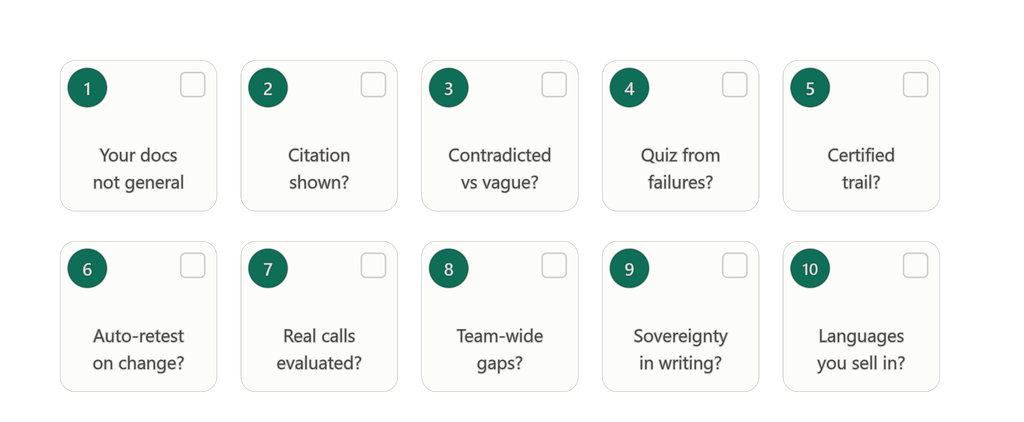
1. Does it verify factual claims against your own documentation, rather than general model knowledge?
This is the foundational question. A platform that only checks whether an answer sounds plausible is grading fluency, not accuracy. The one that matters checks each claim against your product docs, pricing sheets, and policy language — not the model’s general sense of how similar products usually work.
2. Can it show the citation — the exact passage — behind every verification verdict?
A verdict without a source is an opinion. Ask to see the actual document passage a “contradicted” or “incorrect” verdict is based on, not just a label. Many platforms will show you a verdict, a short explanation, and a transcript quote — but not the underlying passage itself. That’s a meaningfully weaker claim than “cites the source,” and it’s worth knowing which one you’re actually getting.
3. Does it distinguish contradicted claims from vague or incomplete ones — including missing disclosures?
A binary right/wrong system can’t represent the difference between “flatly false” and “mostly right, missing a qualifier.” Ask whether the platform has more than two outcomes, and specifically ask how it handles a claim that’s directionally true but omits a required condition or disclosure. That distinction is often where the real coaching value — and the real compliance risk — lives.
Want the reasoning and frameworks behind all ten questions? Our 12-page report, Beyond Roleplay: The Rise of the Sales Knowledge Engine, walks through claim extraction, fact-grounded verification, and the six data-sovereignty questions in full — including the ones we don’t fully pass yet ourselves. [Download the whitepaper →]
4. Does it auto-generate graded quizzes from each rep’s actual failed claims — not a generic question bank?
Generic refresher training doesn’t fix a specific gap. Ask whether a low-scoring session automatically produces a quiz built from what that rep actually got wrong, or whether “remediation” just means assigning the same course to everyone. Also worth asking: does this trigger on real gaps, or does every session get a generic quiz regardless of performance?
5. Does it produce an exportable certification trail — claims tested, document versions, dates?
This is the artifact that turns “we trained on this” into something you can show an auditor or a regulator: which claims were tested, against which version of your documentation, on what date. Session history and quiz scores are useful, but they’re not the same thing as an exportable, dated certification record. Ask to see one, not just hear that it exists.
6. When your documentation changes, does existing certification automatically expire and re-test?
Knowledge goes stale the moment your pricing or policy changes. Ask what happens to a rep’s “certified” status when the underlying document changes — does it automatically expire and trigger a targeted retest on just the changed facts, or does someone have to notice the change and manually assign new quizzes? The honest answer separates a system that stays current from one that just has a good day-one demo.
7. Can it evaluate uploaded real calls with the same rigor as practice sessions?
Practice sessions are controlled. Real calls aren’t. Ask whether the platform can transcribe and evaluate an uploaded real call recording — communication and product-knowledge claims both — with the same checks it applies to a roleplay. Also worth asking: is there a length or quality floor below which a recording won’t get a full report? Very short recordings may not produce one.
8. Does it surface systemic gaps — where a whole team keeps getting something wrong?
An individual score tells you about one rep. The more valuable question is whether the platform rolls that up: which products or topics is the whole team weak on, not just one person. Be specific when you ask this one — “which products are we weak on” and “which exact claims does everyone keep getting wrong” are different levels of detail, and not every platform that claims “systemic insight” gives you the second one.
9. Can it answer data-sovereignty questions in writing?
Call recordings, uploaded documents, and pricing strategy are sensitive. Before anything leaves your environment, get written answers to: which third-party AI vendors process your data, whether your content trains any shared model, what the retention and deletion terms are, whether private or on-prem deployment exists and is generally available, where data is geographically hosted, and whether there’s a regulator-ready record of how staff were trained and verified. A privacy policy with generic language about “service providers” is not the same as written, specific answers to these six questions — ask for the difference directly.
10. Does it work in the languages your reps actually sell in?
Ask this at two levels, because vendors will sometimes answer only the easier one: which languages does the product interface itself run in, and separately, which languages can training content — roleplay, quizzes, evaluations — actually be generated in? Those numbers are often different, and a vendor’s marketing page may only reflect one of them.
How we’d score ourselves
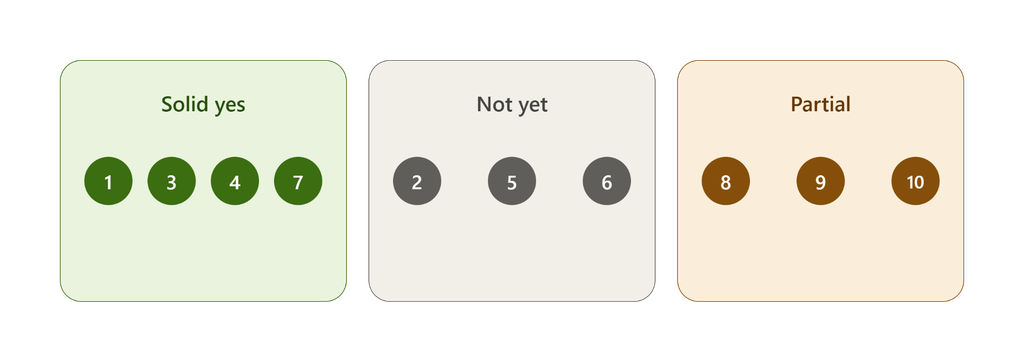
We built this checklist to be genuinely usable against any platform, which only works if we’re willing to run it on ourselves too. Here’s where EOS stands today, honestly:
Solid yes: Claims are checked against your own uploaded documentation, not general model knowledge (Q1). Verdicts go beyond binary right/wrong — a claim can be marked correct, incorrect, unsupported, or partially correct when it’s right on the main point but missing a qualifier (Q3). A low-scoring practice session or uploaded call can generate a quiz from that rep’s actual mistakes, adding extra product questions if there aren’t enough failed claims to build a full quiz from (Q4). Uploaded real call recordings get the same claim-level evaluation as practice sessions, with the caveat that very short recordings may not produce a full report (Q7).
Not yet: We show a verdict, a short reason, and a transcript quote — not the exact document passage behind it, so a real citation isn’t something we can claim yet (Q2). We don’t currently produce an exportable certification trail with document versions and dates (Q5), and updating a document doesn’t automatically expire old results or trigger a retest — that’s still a manual step (Q6).
Partial: Managers can see which products the team is weak on and a rep-by-product accuracy view — real systemic insight, but at the product level rather than “these exact claims everyone keeps missing” (Q8). On data sovereignty: our privacy policy states customer content isn’t used to train models, and our voice roleplay runs on named vendors (OpenAI and Google’s models). The cloud product is hosted in Korea, with no region picker; private or on-prem deployment exists only as a preview, not a self-serve option. Retention terms are covered in the privacy policy, but a customer DPA and a named-subprocessors letter are a security conversation, not a self-serve document today (Q9). And on language: the product interface itself runs in English, Korean, and Japanese, while training content can also be generated in Chinese, French, German, Spanish, Portuguese, Vietnamese, Thai, and Indonesian (Q10).
No fake benchmarks, no rounding up. If a vendor answers all ten of these without a single caveat, ask to see it live before you believe it.
Leave a Reply