A new advisor joined the team on a Monday.
That morning, she took her first real customer call without a senior rep sitting beside her. The customer was a homeowner comparing heat pump quotes. The advisor was nervous, but she’d passed her practice pitch, and her manager had marked her certified.
By lunchtime, she’d uploaded the call recording. By early afternoon, her manager had something the old process never produced: a record of exactly what she’d told that customer, and how each claim held up.
Not just a score. Not a completion certificate. A claim-by-claim breakdown of what she said, whether each statement held up against the company’s own documentation, and a specific list of what she’d gotten wrong.
This is the story of how one energy services company replaced a slow, manual certification process with a same-day claim-level review.
The setup: an industry where “good enough” isn’t
The company sells heat pumps, solar and storage bundles, and dynamic tariffs to homeowners and small businesses. The portfolio changes quarterly. Subsidy rules shift with every legislative session. Pricing adjusts with market conditions.
Their advisory team of 70 reps handles consultations, quotes, and retention calls. Every conversation involves multiple factual claims: system specifications, subsidy eligibility, payback calculations, tariff conditions. A wrong claim about a subsidy program can mean a customer loses thousands of dollars, and the company faces a compliance complaint.
The onboarding process for new advisors was supposed to ensure they could be trusted on live calls. But the certification process itself had a problem nobody had named out loud.
The problem: what “certified” actually meant
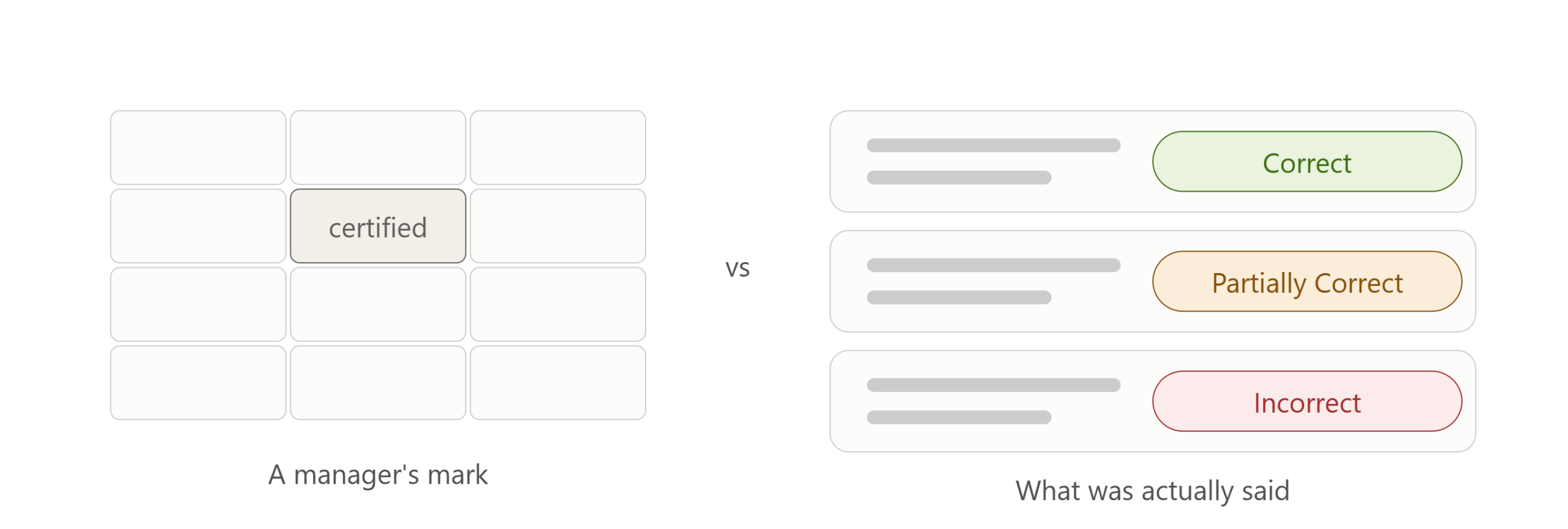
Certification at this company worked like this: a manager sat in on a practice pitch. The manager watched, nodded, and marked the rep as “certified” in a spreadsheet.
That was it.
No transcript. No claim-level check. No record of what the rep had actually said. Just a manager’s judgment call, recorded in a spreadsheet, with no way to reconstruct the pitch afterward.
When a new advisor passed certification on Friday and took live calls on Monday, the company had no way of knowing what she’d actually been certified on. The manager had heard her pitch. That was the extent of it.
“We were calling people certified based on a manager’s memory of a conversation. If a compliance question came up six months later, we had nothing. No transcript. No claim record. Just a cell in a spreadsheet that said ‘passed.'”
The problem with a label alone
The company had tried a partial fix: a practice platform that scored sessions and flagged a rep with a single “needs review” style label when product knowledge looked weak.
But a label by itself wasn’t enough. It told a manager that something might be off. It didn’t say what: no list of the claims behind it, no transcript to check it against, nothing a manager could use to have a specific conversation. It was useful as a nudge. It wasn’t evidence.
“We had a coaching signal. We didn’t have a record. Those are not the same thing.”
The intervention: a same-day, claim-level review
The company built a new process on EOS (app.akaeos.com) around a simple timeline: upload in the morning, review the same day in most cases.
Here’s what actually happens in that window.
The upload. The advisor uploads the call recording. Transcription and scoring run in the background. There’s no progress bar and no live status; the session simply appears in the manager’s list once transcription finishes. For a normal call, this usually takes minutes to tens of minutes, though there’s no guaranteed ceiling. Very short calls may only get a transcript, with no full report.
The claim-level report. The manager opens the session and sees two distinct layers. The first is the claim-level breakdown: every factual statement the rep made during the call (a spec, a price, a subsidy condition), tagged Correct, Partially Correct, Incorrect, or Unsupported, with a short reason and, where available, the exact quote from the transcript that triggered it.
The summary labels. The second layer is two separate summary labels. Product knowledge for that call lands in one of three bands: Stable, Check recommended, or Review needed. Soft skills (tone, pacing, structure) get their own separate label. The two are tracked independently. A rep can be strong on delivery and land on “Review needed” for product knowledge in the same call, and the report shows both, separately. The difference from a label on its own: here, the band sits on top of the claim-level evidence that produced it, so the manager can open the report and see exactly why.
The auto-generated quiz. If the product knowledge score comes in low, something happens without anyone asking for it: a follow-up quiz targeting exactly what the rep got wrong is generated in the background. The rep sees it on their own dashboard. The manager isn’t pinged. If they want to know whether it happened, they check the quiz activity separately.
The workflow doesn’t create a permanent “certified” badge or a blocking status, and the bands are a coaching signal, not a clearance. What it creates is a session-level record a manager can act on, and a transcript-and-verdicts record that a compliance team can go back to later.
What changed in the first month
The company ran the pilot with 25 new advisors over their first 30 days.
Managers saw specifics, not impressions. Instead of “she seemed good,” the manager could say “she got the subsidy eligibility condition partially right. Here’s the exact claim and the condition she left out.”
New advisors discovered gaps they didn’t know they had. The most common errors weren’t obvious falsehoods. They were claims that were directionally right but missing a key qualifier, exactly the kind of error that a manager nodding along in a live practice session would never catch.
The audit question finally had a better answer. For the first time, if a compliance question came up about a specific call, the company could reconstruct it: here’s the transcript, here’s what the rep claimed, here’s the verdict and reasoning on each claim. It wasn’t a document-version-stamped ledger, but it was a real record of what was said and how it held up, instead of a cell in a spreadsheet.
“We used to call people certified because a manager heard them pitch. Now we can actually show what they said, what they got right, and what they got wrong. That’s not the same thing. Not close.”
What does your certification actually prove? Our 12-page report, Beyond Roleplay: The Rise of the Sales Knowledge Engine, covers the verification architecture behind claim-level review, along with the questions worth asking any vendor before you commit. [Download the whitepaper →]
Why this matters for regulated industries
Energy and utilities sit at the intersection of two problems: a product portfolio that changes faster than any individual can memorize, and a regulatory environment where a wrong claim can trigger a compliance complaint, a refund obligation, or a fine.
The company in this story didn’t build a permanent “safe to sell” status that follows a rep around forever. They built something more modest and more practical: a claim-level record for every uploaded call, specific enough for a manager to act on and solid enough for a compliance team to go back to.
That isn’t a formal clearance, and it doesn’t make a rep “safe to sell” on its own. But it’s a more honest starting point than a badge or a spreadsheet cell: a defensible record of what was said, with the reasoning behind how each claim was judged.
The takeaway for sales leaders
If your certification process relies on a manager’s judgment call and a spreadsheet entry, you have a problem you might not see until a compliance question lands on your desk.
A manager nodding along during a practice pitch is not verification. It’s an impression. And impressions don’t leave a record.
What actually works is a workflow where you upload a call, get a claim-level report usually the same day, and see exactly what was right, partially right, and wrong, with the reasoning behind each verdict. Not a permanent status. Not a badge. A record you can act on.
That’s the difference between “we think she’s ready” and “here’s what she said, here’s how each claim held up, and here’s why.”
From “we think she’s ready” to “here’s what she said.” EOS turns uploaded call recordings into claim-level reports, with each claim tagged Correct, Partially Correct, Incorrect, or Unsupported, usually the same day. Start free with up to 5 seats at app.akaeos.com, or [download the full whitepaper].

Leave a Reply