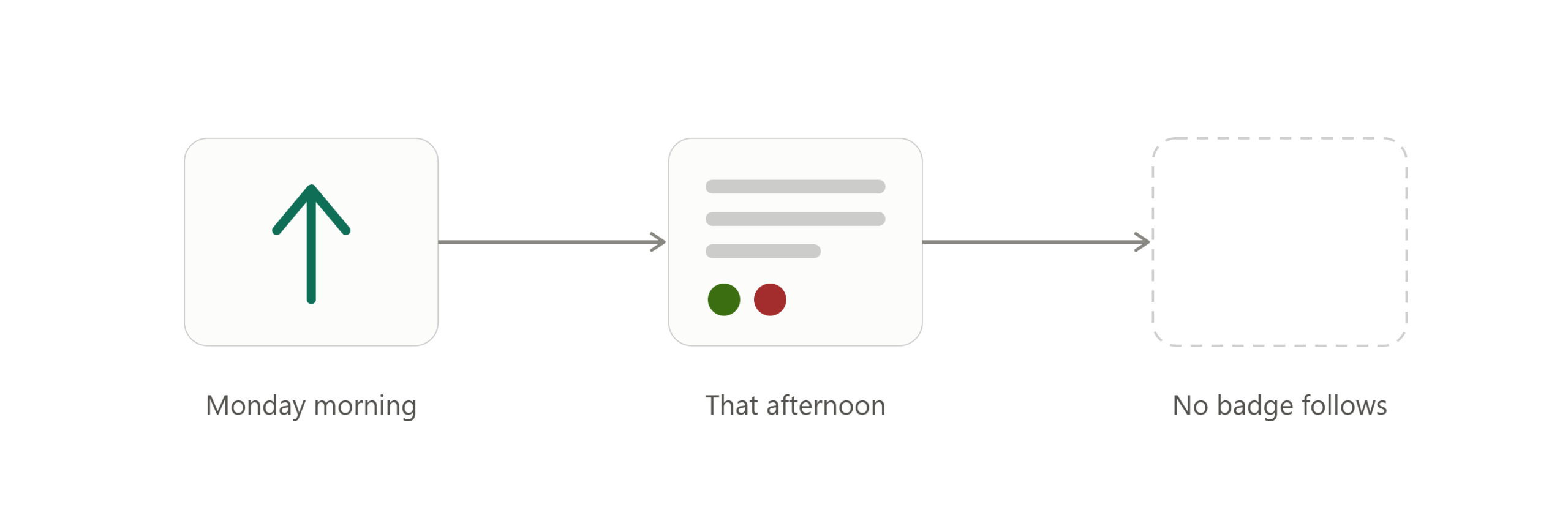
A new rep joins your team on a Monday. That morning, they take a real customer call — their first one without a senior rep sitting in. They upload the recording before lunch.
By that afternoon, what can their manager actually see?
That’s the honest question behind every “safe to sell” or “certified to sell” claim in this category, including our own marketing. So this post walks through exactly what happens between that morning upload and the afternoon review — not the idealized version, the real one.
The upload
The rep uploads the call recording. They get a quick confirmation that transcription and scoring will run in the background — and then it’s genuinely in the background. There’s no progress bar, no live status chip. The session doesn’t show up in the manager’s session list at all until transcription finishes creating it; before that, there’s simply no row yet.
Once the row appears, it updates on its own every few seconds. Open the report early and you might see the transcript with no scores yet — those fill in once evaluation finishes.
For a normal-length call, this whole background process usually takes somewhere between a few minutes and tens of minutes. There’s no promised ceiling — a very long recording or a busy processing queue can push it further out — but under ordinary conditions, a manager is looking at real feedback the same day, often well before end of business.
What the manager actually opens that afternoon
By early afternoon, the manager opens the session report and finds two distinct layers of detail, not one score.
Every factual claim the rep made gets its own verdict. Each claim — a spec, a price, a policy statement — is tagged Correct, Partially Correct, Incorrect, or Unsupported, with the reasoning behind that call and, where available, the exact quote from the transcript that triggered it. This is the layer that actually answers “did the rep get anything wrong today,” claim by claim, not just in aggregate.
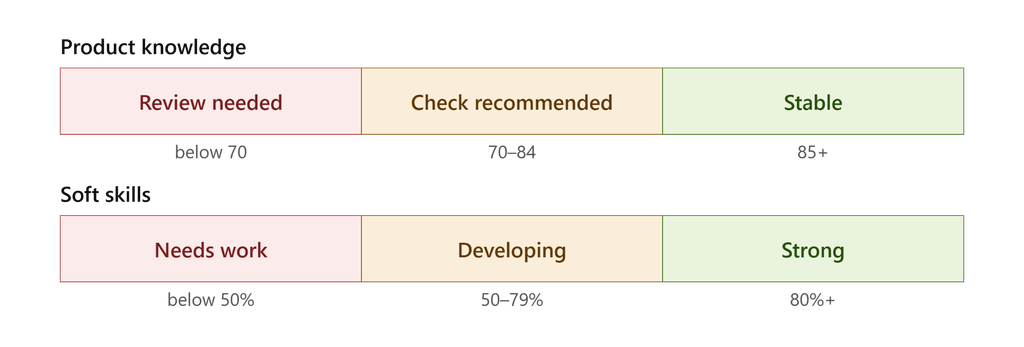
The session also gets two summary labels — on two different scales. Product knowledge for that call lands in one of three bands: Stable (a strong session), Check recommended (some real gaps worth a look), or Review needed (meaningful gaps). Soft skills — tone, pacing, structure — get their own separate label: Strong, Developing, or Needs work. These two labels track different things, use different score bands, and neither one is the same as the team-wide pass-rate number a manager might see on the org dashboard. A rep can be strong on delivery and land on “Review needed” for product knowledge in the same call, and the report shows both, separately.
If that product-knowledge score comes in low, something happens without anyone asking for it: a follow-up quiz targeting exactly what that rep got wrong is generated in the background. The rep sees it on their own quiz dashboard. The manager isn’t pinged about it — if they want to know whether it happened, they check the quiz activity separately.
See the full architecture behind claim-level verification. Our 12-page report, Beyond Roleplay: The Rise of the Sales Knowledge Engine, covers claim extraction, the verification pipeline, and the questions worth asking about audit-readiness before you commit to any platform in this category. [Download the whitepaper →]
What “Review needed” actually means — and doesn’t
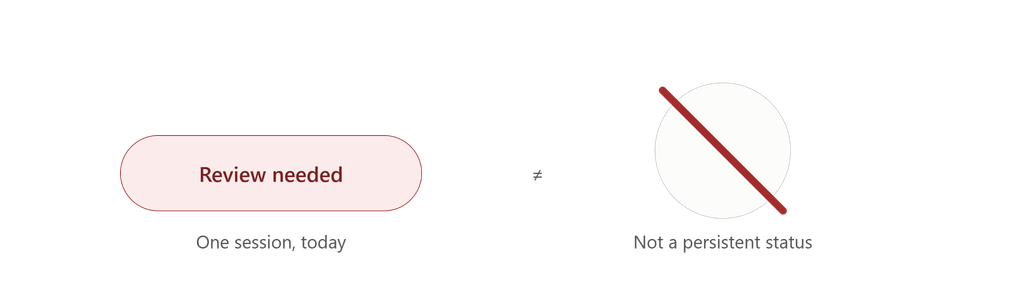
It’s worth being precise here, because this is exactly the phrase that’s easy to oversell. “Review needed” is a same-day, session-level summary of one call’s product-knowledge accuracy. It is not a status that follows the rep around. It’s not a flag that blocks them from taking the next call. It doesn’t expire, escalate, or roll up into any kind of formal clearance. It’s a same-day signal a manager can act on today, for this specific session — nothing more, and nothing less.
What this means if you’re asking the compliance question
If you’re in a regulated industry, the real question probably isn’t “does the rep get a badge.” It’s “if a regulator asks how this rep was trained and verified, what can we actually show them.”
Today, the honest answer is: a lot of session-level evidence, no formal certification package. You can walk an auditor through the transcript, the claim-by-claim verdicts with their reasoning, the scores and labels above, and — when a recording was successfully captured — the original audio itself. Audio capture is best-effort rather than guaranteed; very occasionally a session will show “no recording available” instead. A very short upload may get a transcript with no full evaluation at all, if there wasn’t enough dialogue to score.
What you can’t currently do: export that report as a one-click audit pack, point to a document-version stamp tied to a specific verdict, or produce an artifact that says “this rep is certified against policy version X as of date Y.” On retention, the public privacy policy states that voice recordings are deleted no later than five years after collection — useful as a public baseline, though the specifics a regulated buyer will actually need for a contract usually turn into their own conversation with legal.
One more scope note
Everything above describes an uploaded real call, which is the scenario that actually matters for a compliance conversation. Practice roleplay sessions can end up with the same kind of report — claim verdicts, reasoning, the same two summary labels — but they get there differently: someone has to actively run an evaluation on a practice session before it’s scored, rather than it happening automatically the way an upload does. Practice is real training. It’s just not the same automatic Monday-morning arc.
What this is, and what it isn’t, yet
This is a real, same-day, claim-by-claim account of what a rep actually said and whether it held up — which is already more than a tone score or a completion checkmark gives you. It is not, today, a formal “safe to sell” clearance, an exportable certification artifact, or a compliance product built specifically for regulated industries. Anyone telling you otherwise — including any of our own marketing that gets ahead of this — is describing where the category is headed, not what ships today.
If detailed, same-day, claim-level evidence is useful to you now, and you want to see exactly what a session report looks like on your own documents, that’s a conversation worth having directly.
See your own docs become a knowledge check. EOS turns your product documentation into practice and provable knowledge — claim extraction, fact-grounded verification, and auto-generated quizzes that reveal what reps actually know. Start free with up to 5 seats at app.akaeos.com, or [download the full whitepaper].
Leave a Reply