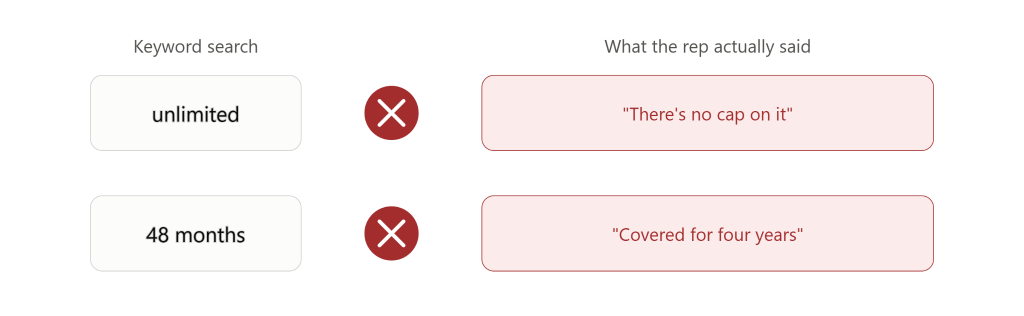
Search a call transcript for the word “unlimited,” and you’ll miss the rep who said “there’s basically no cap on it.” Search for “48 months,” and you’ll miss the rep who said “it’s covered for four years.” Keyword matching only catches what it already knows to look for. It doesn’t understand what was actually claimed.
That’s the limitation most sales call analysis ai tools run into the moment they try to move from transcription to verification. And it’s why the underlying engineering problem — claim extraction — is a genuinely different kind of work than searching a transcript for familiar phrases.
What claim extraction actually is
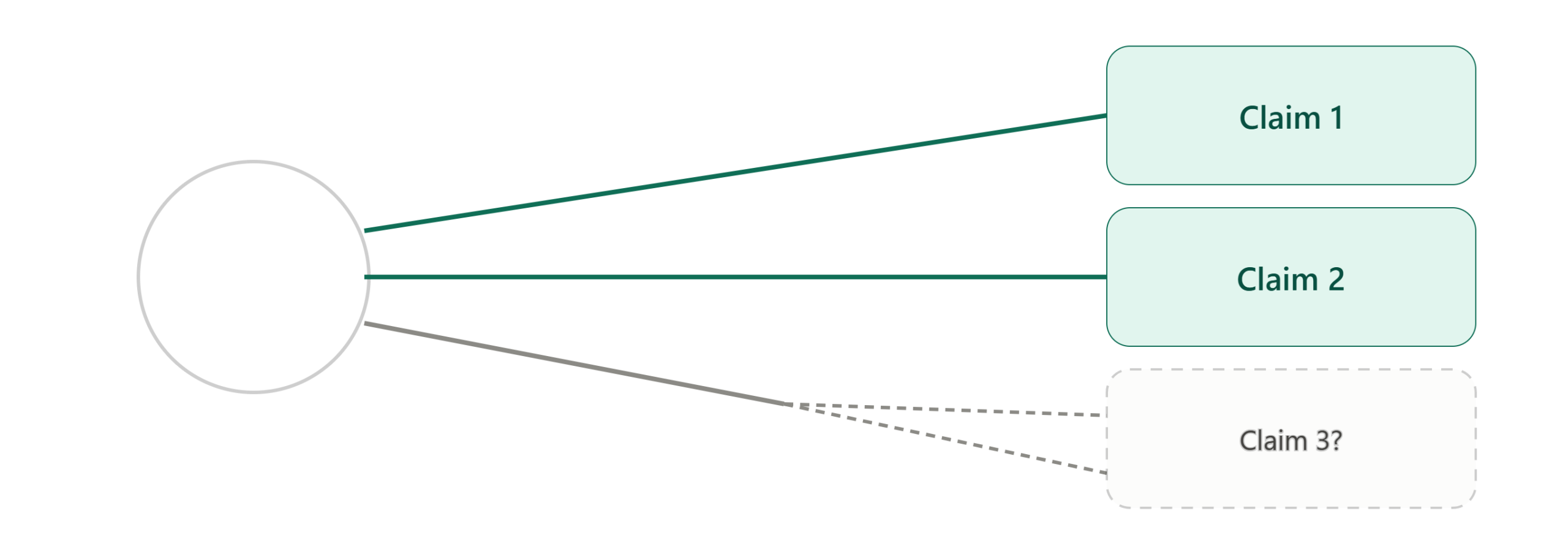
Claim extraction is the process of converting spontaneous, natural speech into a set of discrete, checkable propositions — statements specific enough that each one can independently be marked true, false, or unconfirmable against a source of truth.
That’s a different task from transcription (which just captures what was said) and different again from keyword search or sentiment scoring (which look for patterns without understanding meaning). A transcript tells you the words. Claim extraction tells you what was actually asserted — and where one assertion ends and the next begins.
Why this is harder than it sounds
Consider one sentence a rep might say on a real call:
“Our Enterprise plan basically covers unlimited support, and you’d also get a dedicated rep with round-the-clock coverage.”
A human listening immediately understands this contains at least three separate claims: unlimited support is included, a dedicated rep is included, and coverage is available around the clock. Each of those could independently be true or false — maybe support is included but capped, maybe the dedicated rep only applies to a higher tier, maybe “round-the-clock” actually means business hours in three time zones.
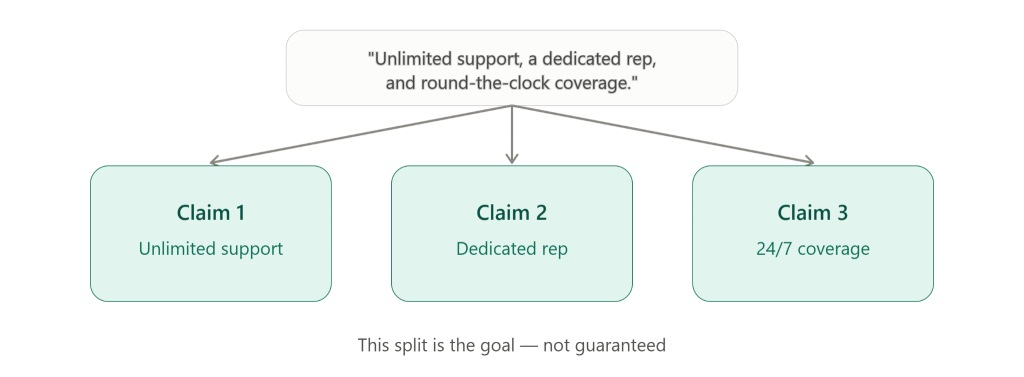
A keyword search has no way to break that sentence apart. It sees one string of words. Extracting three separate, independently verifiable claims out of it requires understanding sentence structure, resolving what “also” and “round-the-clock” are actually modifying, and deciding where one assertion stops and the next starts — none of which is pattern matching.
Real conversations make this harder still:
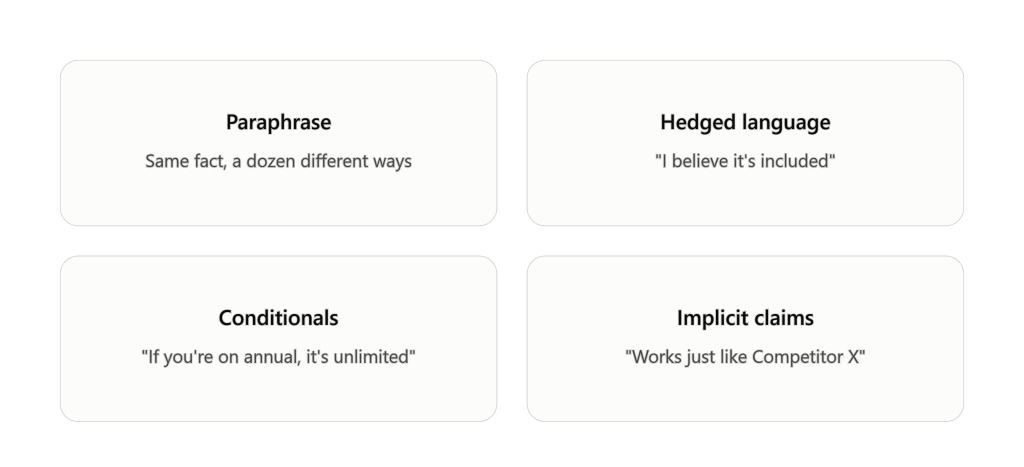
- Paraphrase — the same fact stated a dozen different ways across a dozen different calls, none of which match a fixed keyword list
- Hedged language — “I believe it’s included,” “that should be covered” — claims that are still claims, just wrapped in uncertainty a rep may not even notice they’re signaling
- Compound and conditional statements — “if you’re on the annual plan, support is unlimited” bundles a condition into the claim itself, and losing that condition changes what’s actually being verified
- Implicit claims — a rep who says “it works just like our competitor’s tool” is making a comparative claim without stating a single verifiable fact directly
Transcript search treats all of this as unstructured text. Claim extraction has to turn it into structured, checkable units — and get the boundaries right, or everything downstream inherits the error.
Why extraction quality determines everything downstream
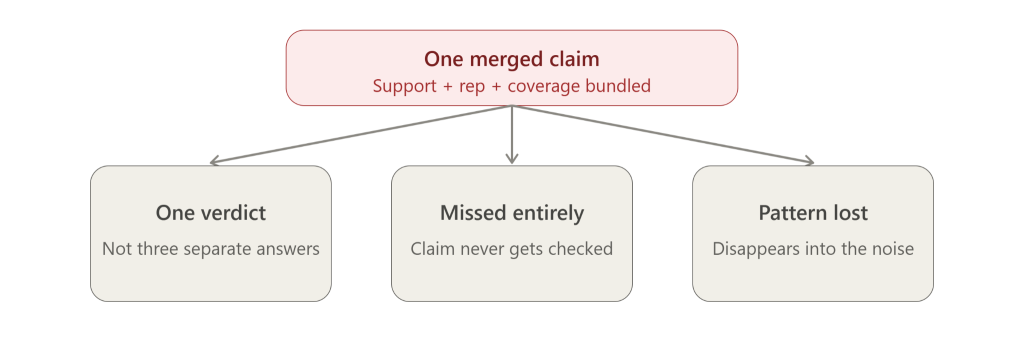
This matters more than it might seem, because claim extraction sits upstream of verification. If a system merges three claims into one, it can only produce one verdict — supported, contradicted, or whatever verdict structure it uses — for something that actually needed three separate answers. If it misses an implicit or hedged claim entirely, that claim never gets checked at all, regardless of how good the verification logic is once a claim reaches it.
In other words: a fact-grounded verification engine is only as good as the claims it’s given to check. Extraction errors don’t get caught by better verification — they just produce confident, well-cited answers to the wrong question.
This is also a fair question to ask a vendor directly, rather than something to assume from a single demo: when a rep bundles two or three claims into one sentence, does the system reliably treat them as separate, independently checkable items — or does the split depend on how the underlying model happens to parse that particular sentence on that particular day? Even strong systems may not guarantee this consistently yet. The honest answer to that question tells you more about the engineering maturity behind a platform than any accuracy percentage a vendor quotes.
See the full verification architecture, not just the first step. Our 12-page report, Beyond Roleplay: The Rise of the Sales Knowledge Engine, walks through claim extraction, fact-grounded verification, and the questions worth asking any vendor about how their pipeline actually works. [Download the whitepaper →]
What good extraction actually produces
Ideally, the output of a claim-extraction step isn’t a highlighted transcript. It’s a structured list: each item isolated as its own claim, with any condition that changes its meaning preserved rather than lost, ready to be checked independently against a source of truth.
That’s a genuinely difficult standard to hit consistently. Hedged language, bundled conditions, and compound sentences all make it easy for a system to merge claims it should have kept separate, or lose a qualifier that changes what’s actually being verified. For the example sentence above, the ideal output is three separate records — one for unlimited support, one for the dedicated rep, one for round-the-clock coverage. Whether a given system reliably produces three records instead of one merged claim is, in practice, still an open engineering question for most of the industry, not a solved problem.
That structure is also what makes downstream reporting meaningful. “Eight of ten reps misstate the dedicated-rep condition” is only a sentence a system can generate if dedicated-rep claims were correctly separated from support claims and coverage claims in the first place. Merge them, and that pattern disappears into noise.
The engineering shift this represents
Most of the AI sales-training market solved a different, earlier problem: generating realistic conversation. That’s a well-understood application of language models, which is why it’s now common across the industry. Claim extraction is a different kind of problem — parsing what was actually asserted, correctly and completely, out of language that was never designed to be structured.
It’s also not a problem that gets solved once. Every new phrasing, every hedge, every compound sentence a rep hasn’t said before is a new case the extraction step has to handle correctly. That ongoing engineering work — not the roleplay generation most platforms now share — is what separates a system that can verify a real conversation from one that can only grade how it sounded.
See your own docs become a knowledge check. EOS turns your product documentation into practice and provable knowledge — claim extraction, fact-grounded verification, and auto-generated quizzes that reveal what reps actually know. Start free with up to 5 seats at app.akaeos.com, or [download the full whitepaper].


Leave a Reply