The head of sales enablement had trusted her platform’s dashboard for eighteen months.
Completion rates were strong. Empathy scores were trending up. Reps were logging hours of practice. Everything looked healthy.
Then she read our audit walkthrough, which suggested a simple test: pick a product fact that had recently changed, state the old value confidently in a practice session, and watch what the platform does with it.
Twenty minutes later, she had her answer. The platform said nothing.
No flag. No correction. No citation. Just a passing score and a note about her “excellent pacing.”
This is the story of what one fintech company found when they ran that test — and what they did about it.
The setup: a clean, checkable fact
The company sells a payment processing and fraud detection platform to mid-market and enterprise merchants. Their product is complex: tiered pricing, volume-based discounts, settlement timelines, and compliance requirements that vary by region and transaction type.
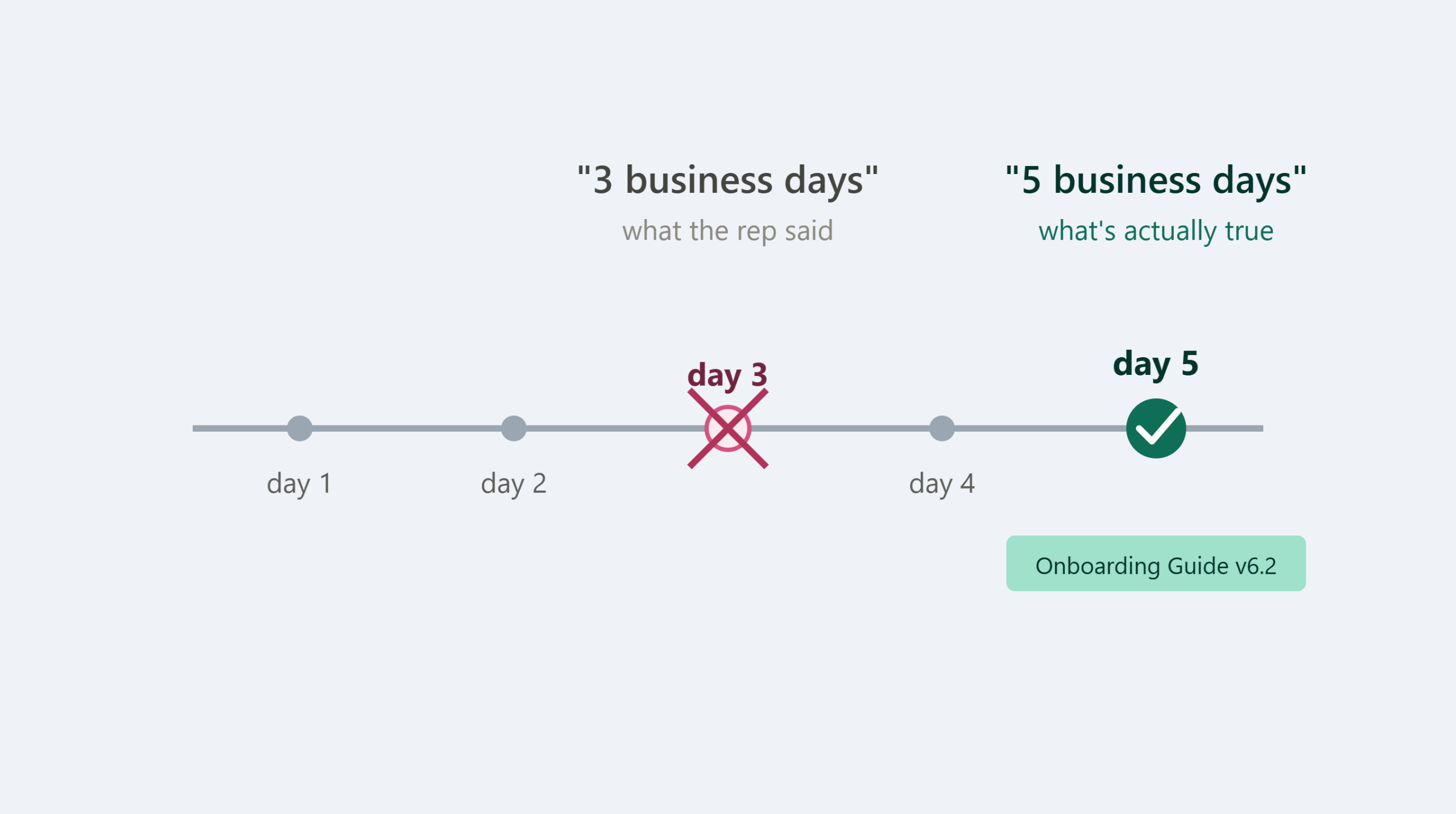
Six months ago, they had changed one specific detail: the standard settlement timeline for new merchants had shifted from “3 business days” to “5 business days” due to new anti-money laundering screening requirements. The change was documented. The sales team had been notified. The internal knowledge base was updated.
But the head of sales enablement had never actually tested whether her AI training platform would catch a rep who still said “3 business days.”
She picked that fact for the audit — a clean, checkable claim with a clear before-and-after.
The test: stating the old value confidently
She ran the test herself, following the same steps outlined in our audit post.
She started a normal practice session on the platform. At a natural point in the conversation, she stated the old value smoothly, with full confidence: “Yes, new merchants can expect settlement in 3 business days.”
No hedging. No “I think.” No “let me check.” Just the kind of confident, fluent statement a high-performing rep would make on a real call.
She completed the session and pulled up the feedback.
The result: silence
The platform gave her a strong score. Empathy: excellent. Objection handling: textbook. Pacing: strong. Overall assessment: passing.
The specific claim she had made — “settlement in 3 business days” — was never mentioned. Not flagged. Not corrected. Not even noted.
The platform had graded her tone, her structure, and her delivery. It had no mechanism for checking the fact underneath any of it.
She ran the second test the audit post recommended: the “insufficient” version. She stated a claim that wasn’t outright wrong, but was missing a required disclosure — specifically, the standard risk disclosure for high-volume merchants. The platform passed that one too, with no comment.
Two tests. Two failures. Twenty minutes total.
The cost of silence
The head of sales enablement shared the results with her VP of Sales. He wasn’t surprised.
He had been tracking lost-deal reviews for two quarters. In that time:
- 13% of lost deals involved a buyer who discovered inaccurate product information during the evaluation
- 9% of support escalations came from merchants who were sold settlement timelines that didn’t match reality
- New reps were taking an average of 8 weeks to reach certification — and many still failed internal product knowledge assessments after certification
The training platform’s dashboard showed strong completion rates and improving empathy scores. But those metrics were measuring that training happened — not that knowledge existed.
The silence in the audit explained why. The platform had no way of knowing whether reps were learning the right things. It only knew whether they sounded good saying them.
Why this industry matters
A wrong settlement timeline doesn’t just cost a deal — it creates real friction downstream. Merchants plan their cash flow around expected settlement dates. When a rep promises 3 days and it takes 5, the merchant’s operations are disrupted, and escalations follow.
There’s also a disclosure dimension. Fintech products come with required notices and jurisdiction-specific language that reps are expected to include consistently. A rep who confidently states the wrong settlement window — or leaves out a required disclosure — isn’t just making a style error; it’s the kind of factual gap that’s especially costly to catch late in a technical, numbers-driven sale like this one.
The fintech head of sales enablement put it plainly:
“We weren’t just losing deals. We were setting expectations that didn’t match reality, and it kept surfacing months later in support tickets. The training platform couldn’t see any of it.”
The intervention: replacing silence with specificity
The company replaced their platform with EOS (akaeos.com) — one that passed both versions of the audit.
When the same claim was made in a practice session — “settlement in 3 business days” — EOS handled it differently:
- It extracted the claim. The statement was isolated as a checkable assertion, not lost in the flow of conversation.
- It checked against the company’s own documentation. The platform verified the claim against the current merchant onboarding guide — not a general-purpose AI’s memory of what “settlement timeline” might mean for payment processors.
- It returned a specific verdict with a citation. Instead of silence, the feedback said:
“Contradicted: New merchants are subject to a 5-business-day settlement timeline. See Merchant Onboarding Guide v6.2, Section 4.1.”
The insufficient version of the test got the same treatment. The missing disclosure was flagged with a specific reference to the policy requiring it.
The difference wasn’t subtle. One platform graded confidence. The other verified facts.
The 90-day results
The company ran the pilot with 45 reps over 90 days.
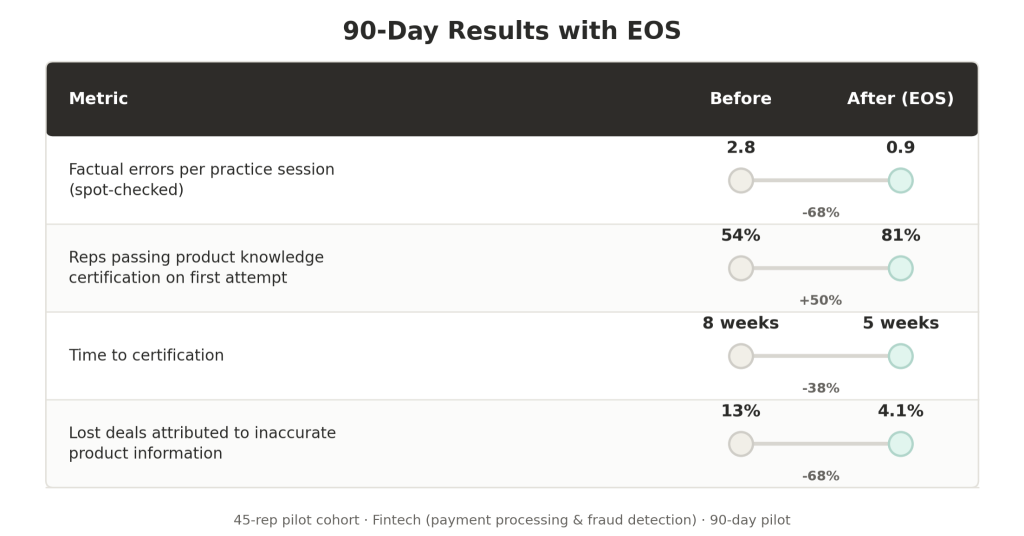
Factual errors per practice session dropped 68% (2.8 → 0.9) — the headline result.
But the head of sales enablement said the real change was simpler:
“Before, I had no idea what my reps were actually saying. The dashboard looked great, but I couldn’t tell you whether anyone was getting the facts right. Now I can. For any rep, on any claim, I can see whether it was supported, contradicted, or insufficient — using EOS’s manager dashboard — and I can see the citation.”
Have you run the 20-minute audit on your stack? Our 12-page report, Beyond Roleplay: The Rise of the Sales Knowledge Engine, includes the complete 10-question stack audit, the fact-grounded verification architecture behind it, and the data-sovereignty questions to ask before you evaluate anything new. [Download the whitepaper →]
Why the audit matters
The audit described in that blog post isn’t complex. It doesn’t require a new tool, a trial account, or a sales call. It requires a login and a fact you already know changed.
But most organizations never run it. They trust the dashboard. They assume the platform is checking what their reps say. They don’t discover the gap until a deal dies — or until they run a simple test and watch the platform say nothing.
The company in this story ran the test and found the gap in twenty minutes. That silence told them exactly what their training program was — and wasn’t — protecting them from. It also told them what to look for in a replacement: not more roleplay generation, not better empathy scoring, but specific, citation-backed verification of every factual claim.
The takeaway for sales leaders
If you haven’t run this audit on your current stack, you don’t know whether your platform is checking facts or just grading confidence.
The test is simple. Pick a fact that changed. State the old value confidently in a practice session. Read the feedback closely.
If the platform says nothing about the claim, you’ve found the gap. It’s not a hypothetical — you just watched it happen on your own platform, with your own documentation, in about twenty minutes.
See your own docs become a knowledge check. EOS turns your product documentation into practice and provable knowledge — claim extraction, fact-grounded verification, and auto-generated quizzes that reveal what reps actually know. Start free with up to 5 seats at akaeos.com, or [download the full whitepaper].
Leave a Reply