The customer standing at your counter, or on the other end of the phone, has already looked it up.
They know the plan’s actual data cap. They’ve read the trim comparison page. They’ve seen the battery benchmark from three review sites, not just the one on your display. By the time your rep opens their mouth, the customer’s fact-check is already live — it happened before the conversation even started, and it’ll happen again the second something sounds off.
Your rep’s fact-check doesn’t have to happen in real time to matter. It just has to happen before the wrong claim leaves the building.
Why memorization doesn’t scale with the catalog
In telecom, automotive, and electronics retail, the thing that makes selling hard isn’t the pitch. It’s the catalog. Feature matrices, trims, tariffs, and bundles change monthly. A rep on the floor might be responsible for dozens of plans or trim levels at once, each with its own conditions, exceptions, and fine print.
Memorizing all of it isn’t a training problem you solve with more hours of roleplay. It’s a scale problem. And when the catalog is bigger than any one person can hold accurately in their head, an outdated answer isn’t a rare slip — it’s a statistical certainty waiting for the wrong shift.
What a wrong answer actually costs here
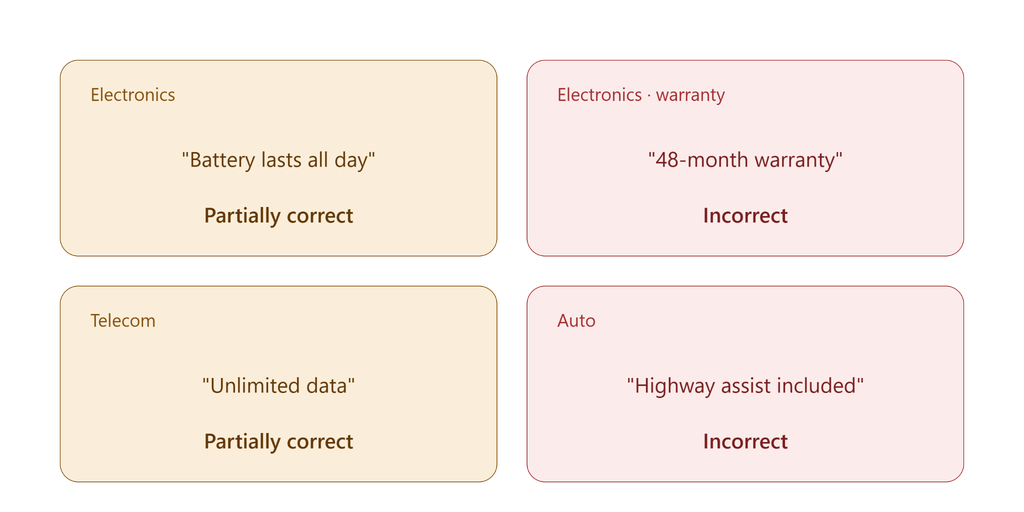
A few realistic examples of exactly this kind of gap:
A rep tells a customer a phone’s “battery lasts all day.” The documentation says up to a specific number of hours of video playback — true under specific conditions, not the blanket claim the customer just heard. That’s not a flat lie. It’s a claim that’s right on the general point and wrong on the detail that actually matters to someone comparing phones side by side.
A rep quotes a “48-month warranty” on a product whose actual documented warranty is 36 months. That one’s a clean contradiction — a specific, checkable number, stated wrong.
A rep sells “unlimited data” on a plan that’s unlimited only up to a documented throttling point. Technically defensible if you squint. Not what the customer heard, and not what they’ll think when their speed drops mid-month.
A rep includes a highway-assist package in a trim description when that package is actually reserved for a higher trim. The customer finds out at delivery, not at the counter.
None of these are hypothetical failure modes unique to bad reps. They’re the predictable result of asking a human to hold a constantly shifting catalog perfectly in memory, under time pressure, in front of a customer who already has a phone in their hand and a competitor’s page open.
See the full framework for high-stakes catalogs. Our 12-page report, Beyond Roleplay: The Rise of the Sales Knowledge Engine, covers the three environments where facts decide deals, the verification architecture behind it, and the questions worth asking any vendor before you commit. [Download the whitepaper →]
The real cost isn’t the lost sale
In high-catalog frontline retail, a wrong answer rarely just loses one deal. It converts a customer who was ready to buy into a customer who buys from whoever gets the answer right — sometimes in the same store, more often at a competitor’s counter twenty minutes later. The damage isn’t contained to the conversation it happened in.
What to actually check before you trust a fix for this
If you’re evaluating whether an AI training or verification tool can handle a catalog this size and this volatile, a few things are worth confirming directly rather than assuming:
Does it scale past a small starter set? Many platforms auto-detect a handful of flagship products to get you started quickly. That’s a reasonable starting point — but ask whether your team can approve the rest of a large catalog, or whether you’re stuck with whatever got auto-detected on day one.
How does it stay current when specs change monthly? Be skeptical of anything implying it updates itself. In practice, someone still needs to re-upload the changed pricing sheet or re-scan the updated spec page as often as your catalog actually changes — monthly, if that’s your cycle. That’s a real workflow to plan for, not a one-time setup step.
Does it treat quick, in-person interactions as a real practice context? A lot of training tools are built around long, scheduled, B2B-style conversations. Frontline retail is often the opposite — a customer walks up, asks two questions, and leaves. Look for a platform that treats that walk-in, counter-style interaction as a legitimate thing to practice, not an awkward edge case.
What happens with very short exchanges? This is worth asking plainly: a thirty-second “what’s the data cap on this plan” exchange may be too short for some systems to produce a full evaluation report. That’s a real limitation in this kind of retail environment, and it’s better to know it going in than discover it after rollout.
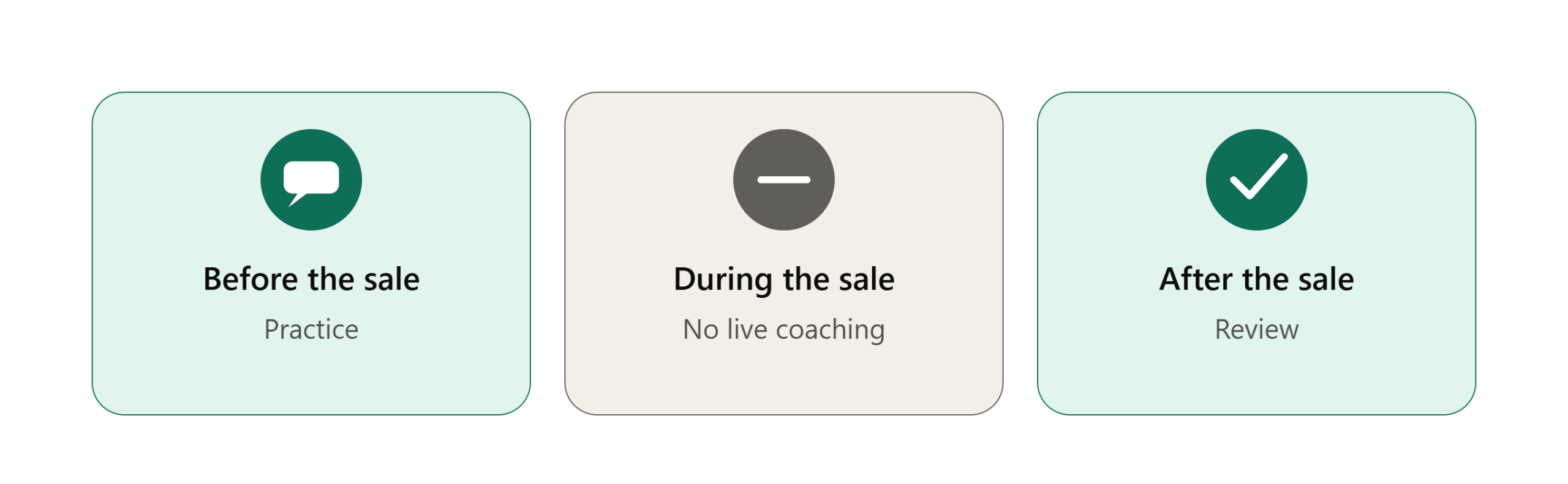
Is verification happening live, or before and after the moment that matters? Be precise about what you’re actually being sold. A system that helps a rep practice the tricky cases beforehand, and reviews real conversations afterward to catch a pattern before it repeats, is doing real work — even though it isn’t whispering corrections into anyone’s ear mid-sale. That’s a meaningfully different (and more honest) claim than implying live, in-the-moment coaching during the conversation itself.
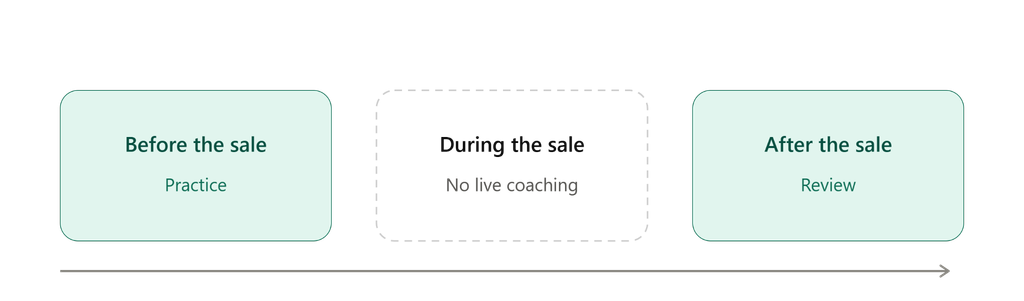
The stakes don’t go away. The gaps can shrink.
None of this makes a large, fast-moving catalog easy. But the gap between “a rep who sounds confident” and “a rep whose confidence is backed by what’s actually true this month” is closeable — if the tool you use is honest about what it does before the sale, what it does after, and how much of your actual catalog it can keep up with.
See your own catalog become a knowledge check. EOS turns your product documentation into practice and provable knowledge — claim extraction, fact-grounded verification, and auto-generated quizzes that reveal what reps actually know. Start free with up to 5 seats at app.akaeos.com, or [download the full whitepaper].


Leave a Reply