The head of sales enablement had checked every box.
Her AI training platform could generate roleplays from any product brochure. Upload a PDF, get a realistic customer conversation in seconds. Create objection-handling scenarios. Build customer personas. Generate quizzes and knowledge checks.
Two years ago, these capabilities felt revolutionary. Today, they’re standard.
Her dashboard looked complete. Roleplay generation was working. Reps were practicing. And yet, when she spot-checked recorded practice calls, she kept finding the same problem: reps were saying things that weren’t true. Confidently. Smoothly. And completely wrong.
The platform was generating great content. It wasn’t verifying anything.
This is the story of how one life insurer — we’ll call them Pinnacle Life — fixed that gap.
The problem: content generation without verification
Pinnacle Life sells term life, whole life, and indexed universal life products through a direct-to-consumer call center and a network of independent agents. Their product portfolio is complex: dozens of policy types, hundreds of riders, pricing that varies by age and health classification, and state-specific disclosure requirements that change every legislative session.
Their AI training platform could generate practice calls from any product document. Reps practiced with AI customers, got scored on empathy and objection handling, and could repeat scenarios as many times as they wanted.
But the platform only graded how reps sounded. It never checked what they said.
When a rep practiced a call and confidently stated that a policy’s cash value growth was “guaranteed” when the contract only showed it as “illustrated,” the platform gave full marks for objection handling. The content of the claim — the truth of it — was never evaluated.
The training platform was a content generation machine. It was not an assessment engine.
The result: reps were getting smoother at delivering wrong information.
The cost of unchecked claims
Pinnacle Life tracked compliance-related call failures for six months before the intervention. The numbers were sobering:
- 12% of all escalated customer complaints involved incorrect product information provided during the sales call
- 8% of applications were delayed or rejected because the initial disclosure was incomplete or inaccurate
- New agents took an average of 9 weeks to reach full certification — and many still failed quality audits after certifying
The head of sales enablement put it bluntly:
We were generating all this practice content, but we had no idea whether our reps were actually learning the right things. We could see they were practicing. We couldn’t see if they were getting it right.
The platform was measuring activity. It wasn’t measuring accuracy.
The intervention: switching from content generation to assessment generation
Pinnacle Life replaced their content-generation-first platform with EOS (akaeos.com) — a system that starts not with generating conversations, but with verifying them.
EOS did four things differently:
- Claim extraction. Every practice call was transcribed. Every factual claim — every policy feature, price point, exclusion, and disclosure — was extracted as a checkable assertion.
- Document grounding. Each claim was checked against Pinnacle Life’s actual product documentation — not a general AI’s memory of what life insurance products might include, but the current, state-specific policy forms, rate sheets, and disclosure language the company actually used.
- Three verdicts. Each claim came back supported (matched the documentation), contradicted (directly conflicted with it), or insufficient (too vague, or missing a required disclosure).
- Auto-generated quizzes. Every contradicted or insufficient claim triggered a personalized, citation-backed quiz for that specific agent.
The shift was fundamental. The old platform asked: “Can we generate a practice conversation?” EOS asked: “Was what the rep said during that conversation actually true?”
The 90-day results
Pinnacle Life ran the pilot with 50 agents over 90 days.
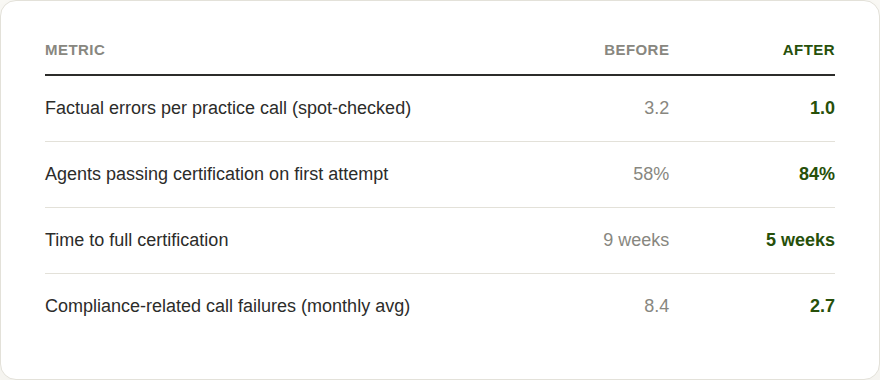
Factual errors per practice call dropped 69% (3.2 → 1.0) — the headline result. Compliance-related call failures fell a comparable 68% (8.4 → 2.7) over the same period.
But the more important shift was in what the team was measuring. Before, the training dashboard showed hours of roleplay completed, number of scenarios generated, and average empathy scores — it measured that training happened. After, using EOS’s manager dashboard, it showed which claims were most frequently contradicted, which agents had the most gaps, and a certification trail for every agent on every product line.
One agent summarized the shift this way:
The old system would just say ‘good job’ and move on. This one actually tells me what I got wrong and shows me the document that proves it. I don’t have to guess anymore.
The takeaway for sales leaders
Content generation — turning a PDF into a realistic practice conversation — is table stakes now. Almost every AI training platform can do it. The question that actually separates platforms in 2026 is whether anyone is checking if what gets said in that generated conversation is true.
If your platform can produce infinite practice scenarios but can’t tell you which claims your reps got wrong, you have a content engine, not an assessment engine. And in a regulated, fast-changing product catalog, that gap is where the expensive mistakes live.

Leave a Reply