Your AI platform can generate roleplays in seconds. Upload a product manual, and it creates realistic customer conversations. Generate objection-handling scenarios. Build customer personas. Create quizzes and knowledge checks. Just two years ago, these capabilities felt revolutionary. Today, they’re becoming standard.
Nearly every AI sales training platform can generate content now. That’s no longer the interesting question in a sales enablement assessment in 2026. The interesting question is this:
When a rep says something during that roleplay, who checks whether it was true?
Content generation is becoming a commodity
Modern AI models are remarkably good at creating training content. Give them a product brochure, and they’ll produce practice conversations. Upload documentation, and they’ll generate quiz questions. Ask for a difficult customer, and they’ll create a believable persona with realistic objections. These capabilities are valuable.
But they’re also becoming expected.
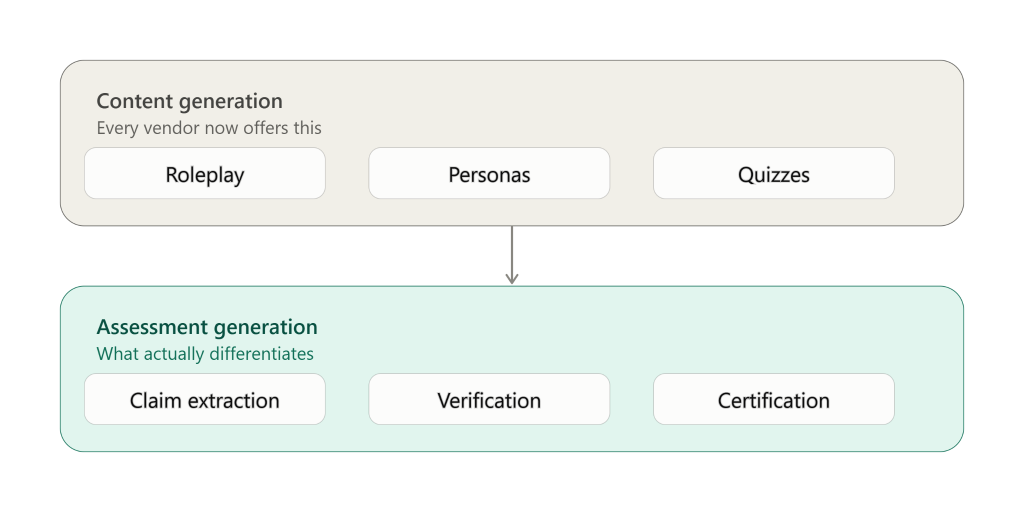
As general-purpose models keep improving, the gap between vendors on content generation keeps shrinking. If every platform can generate a roleplay from an uploaded PDF, roleplay generation is no longer the competitive advantage. Any ai sales training comparison you run today will show the same feature checked on every vendor’s list. When every demo looks the same, the decision collapses into price — and training outcomes stay flat.
The harder problem isn’t creating conversations. It’s verifying them.
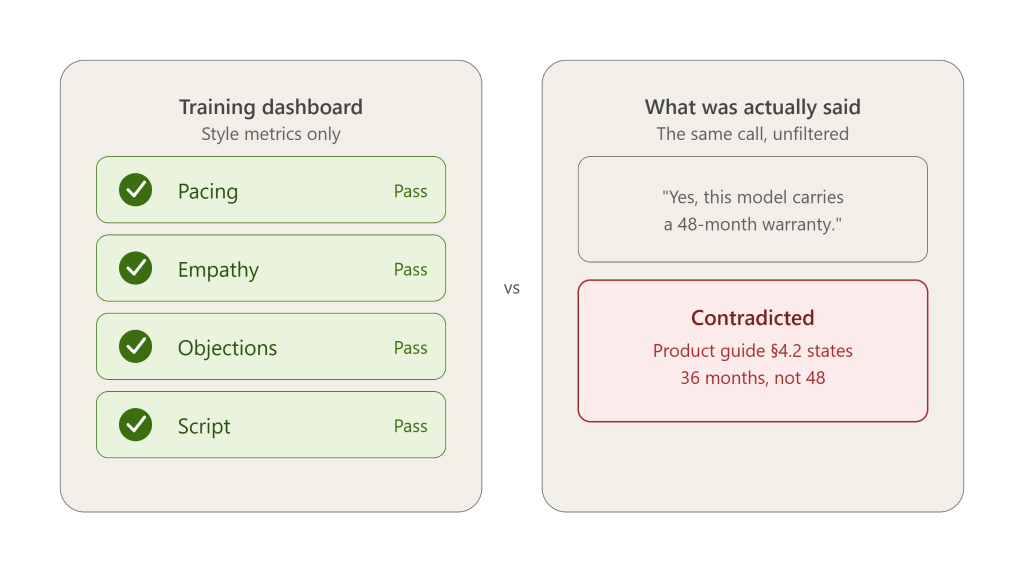
Here’s where most platforms stop: they grade the shape of the conversation that content generation produced. Good pacing. Active listening. Open-ended questions. Textbook objection handling.
Those are real skills, and a generic rubric can score them reasonably well. But notice what a rubric like that can never tell you: whether the specific facts the rep just stated were correct.
That requires a different kind of system — one that doesn’t just grade tone, but does four things:
- Extracts every factual claim the rep made during the conversation — each spec, price, condition, or compliance statement, isolated as something that can actually be checked.
- Verifies each claim against the company’s own documentation — not a general model’s memory of similar products, but this company’s current catalog, pricing, and policy.
- Returns one of three verdicts: supported (matches the documentation), contradicted (conflicts with it), or insufficient (too vague, or missing a required disclosure) — each with a citation back to the source.
- Turns the misses into a targeted quiz built specifically from what that rep got wrong.
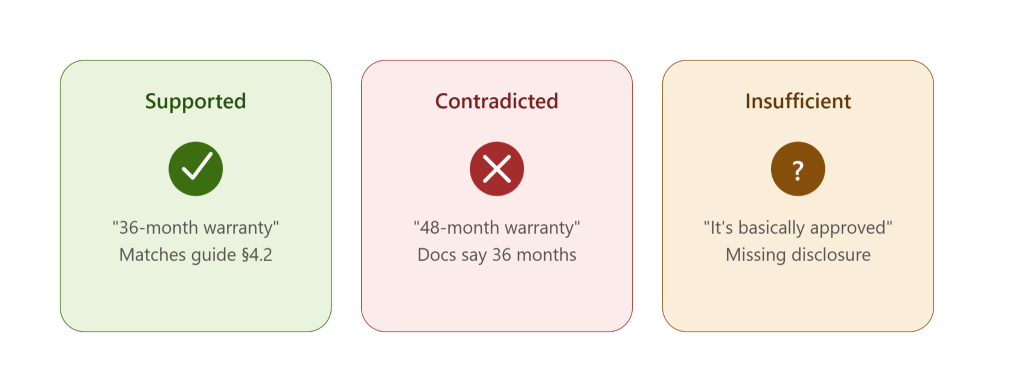
This is the real distinction behind “assessment generation.” It isn’t a fancier scoring dial on the same rubric. It’s a shift from judging how something sounded to judging whether it was true — and that shift only works if the ground truth is the company’s own documents, not the model’s general training data.
Why one rubric can’t serve every company
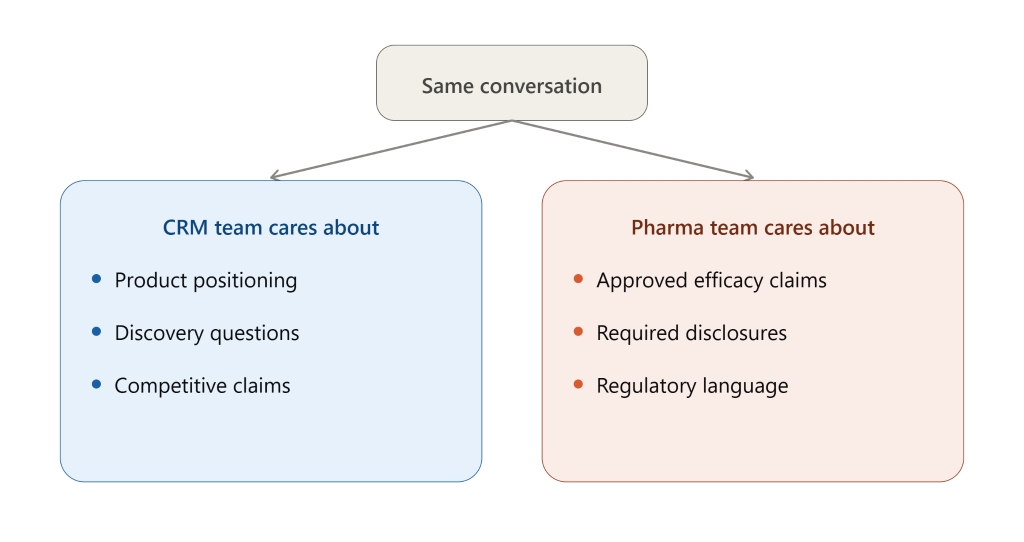
Imagine two companies using the exact same AI-generated roleplay engine. One sells CRM software. The other sells pharmaceutical products. Should a rep’s practice call be evaluated the same way?
Of course not.
The CRM company might care most about product positioning, discovery questions, and competitive differentiation. The pharmaceutical company may care far more about whether every efficacy claim was approved language and every required disclosure was actually said out loud.
The conversation could be identical. The set of claims worth checking should not be.
This is exactly why a generic AI rubric — the kind built into most roleplay platforms — falls short. It rewards good pacing and active listening for everyone, because that rubric was never built from your documentation. It has no way of knowing that your pricing has a condition that changed last quarter, or that your industry requires a specific disclosure your competitor’s doesn’t.
A verification system has to start from the same place: your product pages, your pricing sheets, your compliance language — not a generic template applied to every customer.
Consistency creates confidence
One of the biggest challenges in sales coaching is consistency. One manager focuses on discovery. Another prioritizes objection handling. A third pays close attention to technical accuracy. Ask five sales leaders what “a good call” sounds like and you’ll get five different answers.
Fact-grounded verification doesn’t replace that coaching — it gives it a stable floor to stand on. When every rep’s claims are checked against the same current documentation, every manager is working from the same set of facts about what was actually said, and what was actually true. Coaching still varies. The verdicts don’t.
The next generation of AI sales training
Content generation changed sales enablement. It made practice cheap and scalable, and that mattered. But it’s no longer what separates a serious training program from a checkbox one.
Verification is the harder problem — and the more valuable one. Building conversations is easy now. Building a system that knows, claim by claim, whether what was said matches what’s actually true about your business is not. The organizations that get the most out of AI training in 2026 won’t just generate more practice. They’ll be able to answer, for any rep, on any claim: supported, contradicted, or insufficient — and here’s the citation.
That’s the distinction every CRO needs to understand this year.

Leave a Reply