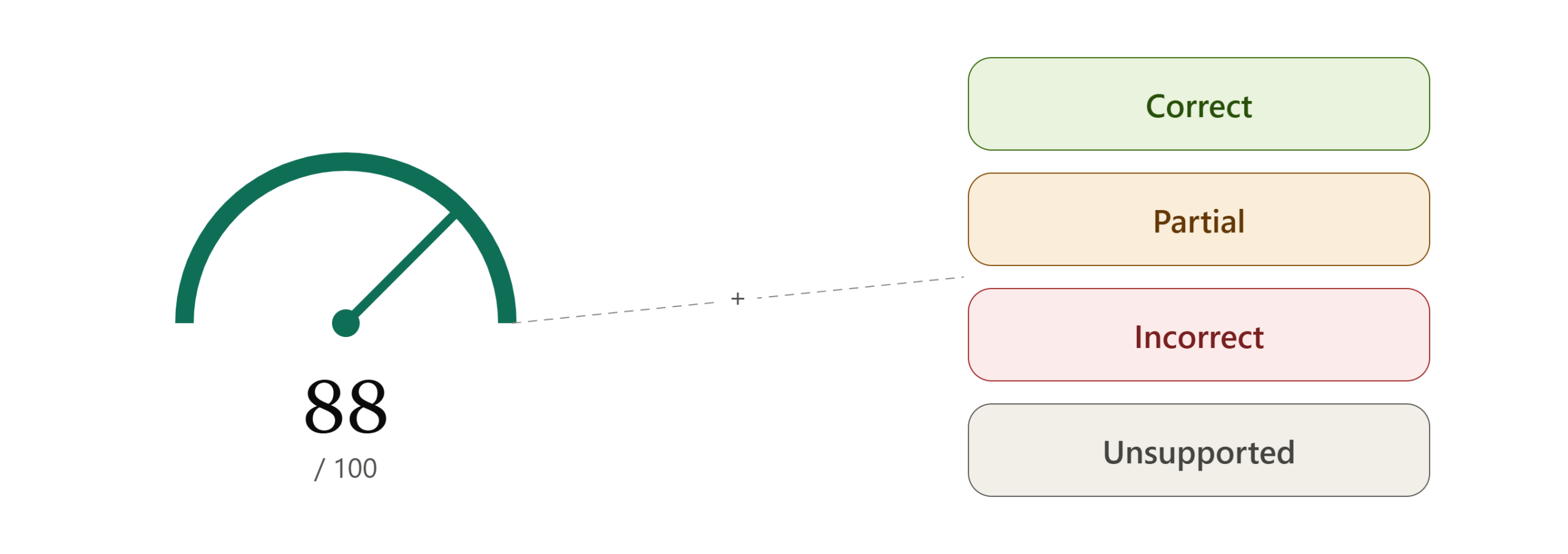
A rep finishes a practice session and gets an 88 out of 100.
Is that good? Probably. Is it good enough to send them into a renewal call for your most technical account next week? The number alone can’t tell you. It doesn’t say which 12 points were lost, whether they were lost on tone or on a product fact, or whether the same gap shows up in every session this rep runs.
A score tells a manager how a session went. It doesn’t tell them why — and “why” is the only part that’s actually coachable.
What a bare score can’t do
Scores are useful for trends. An 88 this week compared to a 74 last month tells you something is improving. But a single number collapses everything that happened in a session — tone, pacing, product accuracy, compliance language — into one figure, and once it’s collapsed, you can’t get the detail back out.
That matters more than it sounds like it should, because two reps can land on the same 88 for completely different reasons. One lost points on pacing and hesitation. The other lost points because they stated a product capability that isn’t actually true. Those are not the same coaching conversation, and a score alone gives a manager no way to tell them apart.
Verdicts add the layer a score is missing
This is where claim-level verdicts come in — not as a replacement for the score, but as a second layer underneath it. Instead of asking only “how well did this session go,” a verdict system asks, for each specific product claim a rep made: was that claim actually accurate?
Different platforms use different numbers of categories — some use three, some four — but the useful ones go beyond a simple right/wrong. A workable structure looks something like this:
- Correct — the claim matches current product information
- Partially correct — the main point is right, but an important qualifier, exception, or limitation was left out
- Incorrect — the claim conflicts with the product information
- Unsupported — there isn’t enough information available to confirm or deny the claim as stated
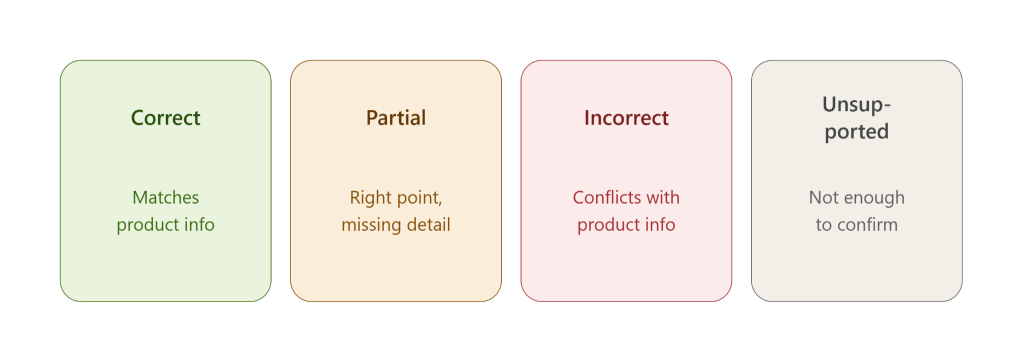
That middle category — partially correct — is where most of the real coaching value lives, and it’s also the category a plain score can’t represent at all.
Why “partially correct” is the interesting one
Consider a rep who says a device offers “all-day battery life.” That’s not a clean contradiction — the claim is directionally true. But if it’s only true under specific usage conditions the rep didn’t mention, the claim isn’t fully correct either. It’s something in between: right on the main point, incomplete on the detail that actually matters to the customer.
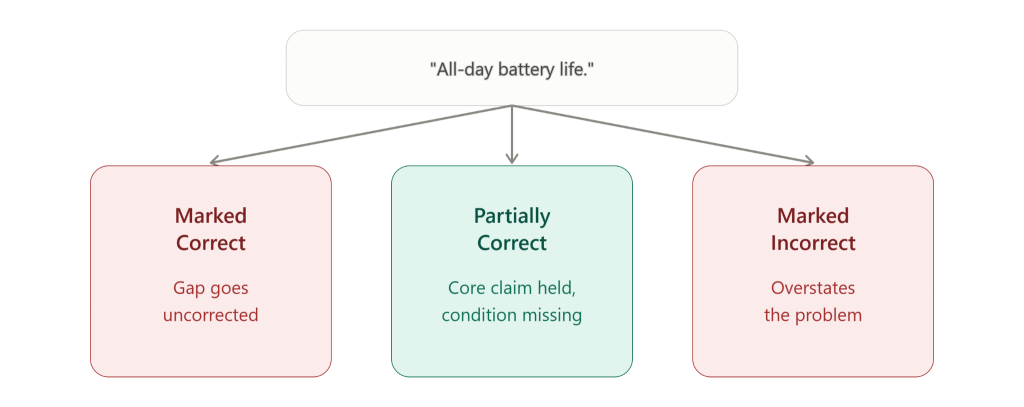
A binary right/wrong system has no good place to put that claim. It either gets marked correct (which lets a real gap through uncorrected) or incorrect (which overstates the problem and makes the rep defensive about something they mostly got right). A four-category system can say exactly what happened: the core claim held up, and here’s the specific condition that got dropped. That’s a coaching note a manager can actually act on — “always mention the usage condition” is a concrete instruction, where “improve product knowledge” is not.
- See the full verification architecture behind this. Our 12-page report, Beyond Roleplay: The Rise of the Sales Knowledge Engine, covers claim extraction, the fact-grounded verification pipeline, and the KPI framework that replaces “hours of roleplay completed” with numbers a CFO actually accepts. [Download the whitepaper →]
Why a missing disclosure isn’t quite the same problem
In regulated selling, there’s a related but distinct failure mode: a rep who never mentions a disclosure their policy requires at all. That’s worth separating clearly from the four claim verdicts above, because it isn’t really a claim that turned out to be wrong — it’s the absence of something that was supposed to be said in the first place.
Treating this as its own category, tracked alongside claim-level verdicts rather than folded into one of them, actually matters for accuracy. A missing disclosure isn’t “unsupported” (the rep didn’t make an unverifiable claim — they made no claim on that point at all), and it isn’t quite “incorrect” either (nothing they said was factually wrong). It’s a gap in what should have been covered, and it deserves to be tracked as its own kind of miss. In regulated industries, this is often the costliest gap of all, precisely because a tone-and-fluency rubric has no way to notice something that was never said.
The score and the verdicts, together
None of this means the score becomes irrelevant. A single number is still the fastest way to see whether a rep, a team, or a whole cohort is trending in the right direction over time — that’s exactly what a score is good at, and verdicts aren’t a replacement for it.
What changes is what happens after the number. Instead of a manager staring at an 88 and guessing what to coach next, they can look at the claim-level verdicts underneath it and see precisely which claims were correct, which were partially right but missing something, which were flatly wrong, and which couldn’t be confirmed at all — plus whether any required disclosures were skipped entirely. The score answers “how did this session go.” The verdicts answer “what, specifically, should this rep work on next.” A serious sales knowledge assessment rubric needs both layers, not one instead of the other.
What this means for certification metrics
This same logic extends past a single session. Reducing a rep’s readiness to one certification score creates the same blind spot as reducing one session to one number — it tells you a rep passed, but not what they’re actually strong or weak on. Sales certification metrics built on claim-level verdicts, rather than a pass/fail threshold alone, give managers something they can act on immediately: not just who’s certified, but which specific claims, conditions, or disclosures need another look before the next customer conversation.
- See your own docs become a knowledge check. EOS turns your product documentation into practice and provable knowledge — claim extraction, fact-grounded verification, and auto-generated quizzes that reveal what reps actually know. Start free with up to 5 seats at app.akaeos.com, or [download the full whitepaper].

Leave a Reply